Deep focus at work doesn't happen because you decided to concentrate harder. It happens because you set the right conditions. Your environment, your mindset, and your energy level all either support focused work or work against it. Understanding which levers to pull and in what order is what separates people who get deep work done from those who stay busy without making progress.
Why It Matters
Most focus advice stops at removing distractions. That's necessary but not sufficient. And yes, clearing notifications and going offline are optimization steps worth taking. But getting into genuine deep work requires three distinct anchors working together: your environment, your mind, and your energy. Miss one and the other two carry more weight than they should. This is the practical side of what the science behind distraction and decision fatigue actually demands.
What You'll Learn
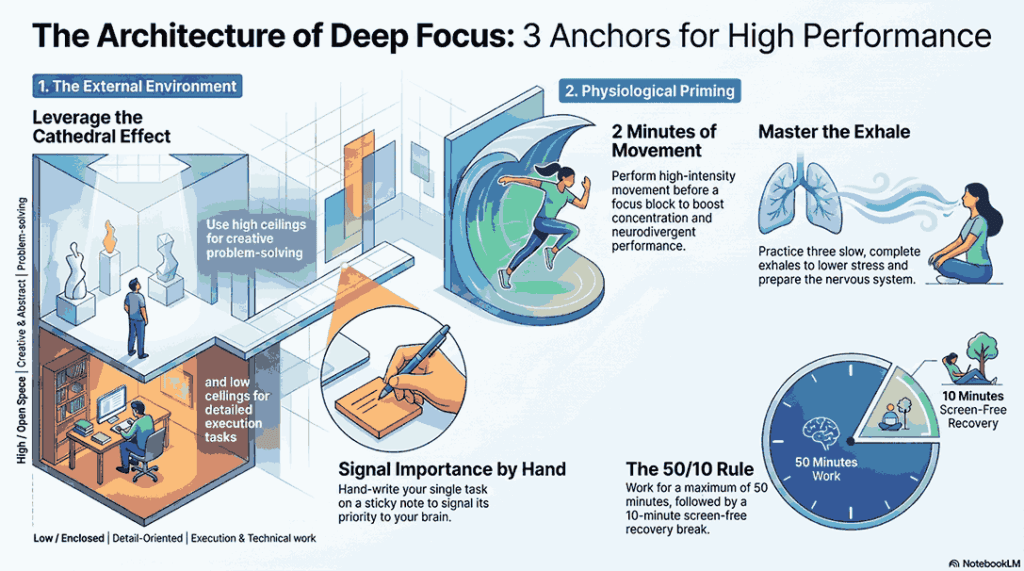
- How to set up your physical environment for deep work, including the cathedral effect and why the room you choose changes the kind of thinking you can do
- Why writing down the one thing you are working on by hand, not typing it, signals to your brain that the task is important
- How to use timed focus blocks effectively, including why 50 minutes is the ceiling and what a real break actually looks like
- How two minutes of high-intensity movement before a focus block can improve concentration, especially for anyone with ADHD or on the neurodivergent spectrum
- Why the exhale, not the inhale, is the breath that actually calms your nervous system and prepares your brain for focused work
FAQ
What is the cathedral effect? The cathedral effect is a research-backed phenomenon in which your physical environment shapes the type of thinking you can do. High ceilings and open outdoor spaces make you more likely to think creatively and solve problems. Low ceilings and enclosed spaces help you buckle down and execute. Choosing the right room for the right kind of work is not a preference. It's a performance variable.
Why write down my focus intention by hand instead of typing it? Writing activates a different cognitive process than typing. When you write something down by hand, your brain registers it as more significant. A sticky note with the one thing you are working on isn't a productivity ritual. It's a signal to your brain about what matters right now.
How long should a deep work block be? No more than 50 minutes. Research puts peak productivity time at around 52 minutes, but 50 is a clean number. After that, take a real 10-minute break. Not email. Not Slack. Something that lets your brain recover so the next block is as productive as the first.
What counts as a real break? Anything that isn't screen-based and not work-adjacent. Move, go outside, get water, breathe. Checking email during a break is not a break. It's the start of a new decision fatigue cycle.
How does movement help with focus? Two minutes of high-intensity movement before a focus block can meaningfully improve concentration. This is especially well-documented for people with ADHD, but the benefits extend to people who are not on the neurodivergent spectrum as well. Movement is not a reward for finishing work. It's a tool for doing it better.
Why does the exhale matter more than the inhale? When you tell someone who is anxious to take a deep breath, they tense up. Inhaling activates the nervous system. The exhale releases it. You can't fully tense while exhaling. Three or four slow, complete exhales before a focus block help lower your physiological stress response and prepare your brain for sustained attention.
Resources
- Watch the full clip: Three Attention Anchors That Get You Into Deep Focus
- Book: Reclaim Your Workday
- Health-Powered Productivity Podcast: available wherever you listen to podcasts
- Weekly tips: Weekender Snapshot
Does your team need help learning how to get into deep focus at work? Contact us today!