
Think about a top priority in your life right now. A health habit you keep restarting. A relationship you keep saying matters. A project that stays at the top of the list and never gets the dedicated time.
You know what it is. You've probably known for months. And you still can't get to it half the time.
Sometimes that's because we call something a priority just because we think it's supposed to be one, when the honest answer is that we aren't that interested. Sometimes it's a discipline problem, and there's a straightforward fix for that: write it down, and tell someone. I share my quarterly priorities with three friends and my husband, and I keep them on a whiteboard, in my Powered Path Playbook, and in ClickUp.
But when you genuinely do want to prioritize something and it still doesn't happen, the problem is sometimes one of three things. They look identical from the outside and they need completely different fixes.
levels of prioritization
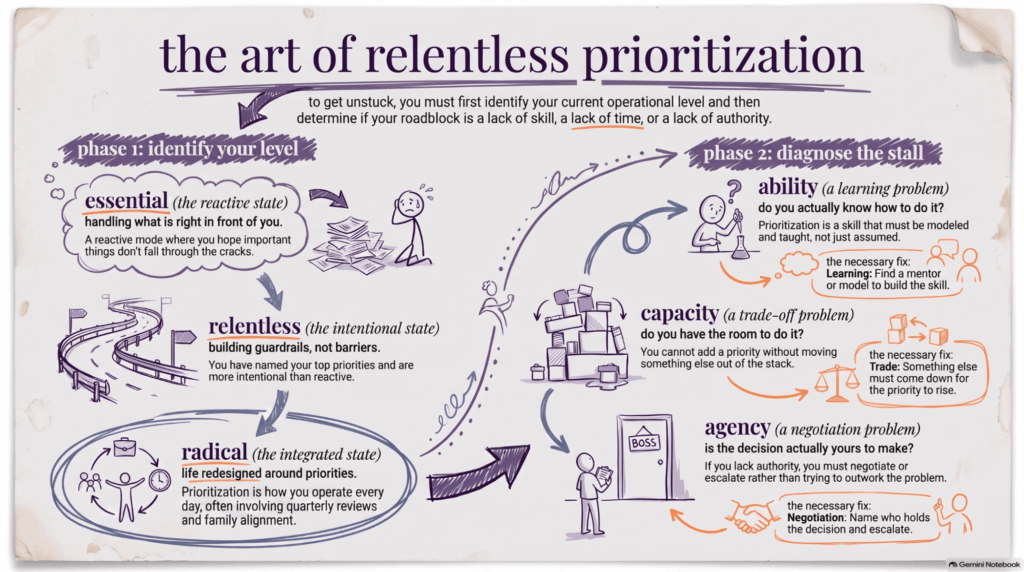
Before you can fix a stalled priority, you need to know your baseline. There are three levels, and most people can place themselves in about ten seconds.
Essential. You don't really have a system, or the one you have is reactive. You respond to what shows up. You remember the email blast the day you launch the product. You remember the birthday because Facebook told you. You handle what's in front of you and hope the important things don't fall through the cracks. Sometimes they do. There's nothing wrong with you for being here. Plenty of people are.
Relentless. You've named your priorities. You work from a top three, professionally and personally. You're more intentional than reactive. You don't always get it right, but you know what right looks like for you. You've built guardrails rather than barriers. When I'm driving the Blue Ridge Parkway, I want a guardrail. A barrier blocks the view. A guardrail lets me see the path forward and still feel safe.
Radical. You've redesigned your life around your priorities. Quarterly review partners. A family that sets priorities every January. Prioritization is how you operate.
Radical isn't the goal. Knowing where you are is important because the fix for a stalled priority depends on the level you're operating at and on which of the three problems you actually have.
A note on the phrase underneath all of this: relentless prioritization beats endless optimization. Most of us are optimizing, and optimization can quietly make the wrong things faster and leaner without anyone asking whether they deserve to exist. I'll go deeper on that distinction in an upcoming episode.

Ability, capacity, agency
Ability is the skill to prioritize, and it doesn't transfer just because you got promoted or reached a certain age.
One of my clients spent ten happy years as a bench scientist with a pipette in her hand. One experiment, one question, one data set at a time. Then she got a team of four, one-on-ones on her calendar, a budget with her name on it, and a board meeting twice a quarter where she had to explain a slipped timeline to people who didn't know a western blot from a whiteboard.
She knew how to prioritize research. Prioritizing for a team had never been modeled or taught. We should never assume people already know how.
Capacity is room. Brad got a pre-diabetes diagnosis and clear instructions from his doctor. He had the ability; he knew exactly what to do. He had agency; he was making conscious choices about his time every week. The problem was that those choices already had somewhere to go. Two kids, eight and ten, and he was coaching their baseball team. That was a real priority and he was living it. What it left for his health was nothing. Coaching kept him out late, and stopping at Chick-fil-A on the way home was easier (and he wasn't ordering the kale salad).
He wasn't failing. He was succeeding at one priority and paying the price in another. The fix wasn't trying harder. It was looking at the rest of the stack and finding something else that could move.
Capacity is also where neurodivergence often shows up. When the structure, environment, or support isn't right, what looks like an inability to prioritize is usually a conditions problem, and the right setup changes everything.
Agency is whether the decision is yours to make. Another client broke her foot. Boot, crutches, six weeks, couldn't drive. She suddenly had more capacity than she'd had in years, because half her obligations became physically impossible. What she didn't have was agency. She needed someone to get her groceries and drive her to PT, and she waited on whoever had room in their week. Someone else was running her schedule.
You may recognize this if you manage a project or a team and can't get resources. You know exactly what you need. You just don't have the authority to hire.
The three questions
Ask yourself right now:
- Do I know how to do it?
- Do I have the room to do it?
- Am I actually the one deciding?
Wherever you get stuck, that's where you begin.
The test
Suppose a journalist were following you for three days. What would they actually see?
Would they write down that you're living your stated priorities? Would they see you protecting the time you said you'd protect? Or would your actions tell a different story?
It's your calendar that shows up in that story, and what you decide when something else tries to take the slot.
Three problems, three fixes
Ability is a learning problem. Find someone who does this well and get close to them. That skill can be built.
Capacity is a trade. The priority doesn't rise unless something else in the stack comes down.
Agency is escalation or negotiation. You can't outwork your way to a decision that isn't yours to make yet, but you can name who's holding it and start there.
And you can't fix any of them by trying harder.
Go back to the priority you had in mind at the start. Name which one is stopping you. Out loud. That's the first step, and it's the one most people skip.
The Right Things First: A Pocket Guide to Relentless Prioritization is the pocket version of this framework. Learn more here.