Screen apnea is the tendency to hold your breath while you stare at a screen. You may have heard of sleep apnea, where breathing stops during sleep. This is the daytime version, and most of us do it without noticing.
Where I learned about screen apnea
I first read about it in James Nestor's book, Breath. It explained something I'd seen a few years earlier. My husband would sit in bed with his iPad (not #MarceyApproved), and make these little puffs of breath.
Me: "Why are you breathing weird?"
Him: "I'm not breathing weird."
He was holding his breath. It was definitely weird.
I looked into this further, and from what I understand, the closer the screen is to your face, the more likely you are to hold your breath. I also notice it more when we switch context.
Every room has someone who does it
Whenever I bring this up in a program, someone realizes they do it too.
At the Georgia Society of CPAs, I asked everyone for one commitment for the next week. Four people raised their hands. Three of the four chose breathing.
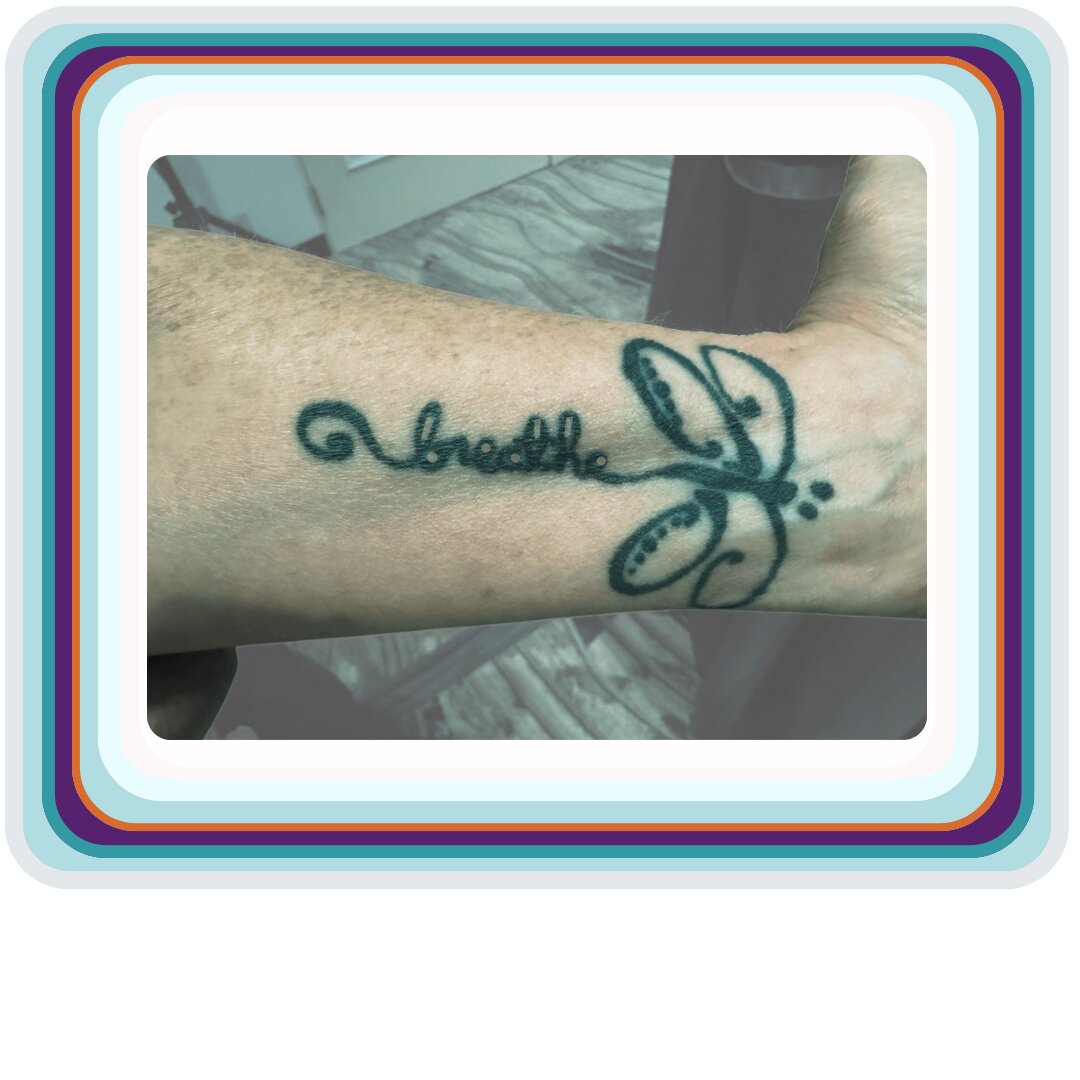
During a break, Michelle Anthony showed me the word "Breathe" tattooed on her arm. She got it as a reminder after realizing she'd been holding her breath.
At the Michigan Association of CPAs, a woman started laughing while I talked about this. People around her always assumed she was mad because she occasionally let out a big sigh. Now she knows the sigh was a delayed exhale.
Focus on the exhale
It sounds counterproductive, but when we exhale, our bodies relax. Take a deep breath while tensing up a little, and on the exhale your shoulders drop, and your body settles. It's a reset for your body and nervous system.
Researchers call this pattern cyclic sighing: deep breaths followed by longer exhales. Earlier research has linked sighing to psychological relief and a reset of breathing rate.
A Stanford study published in Cell Reports Medicine tested it. About a hundred people, mostly students, spent five minutes a day for a month on either mindfulness meditation or one of three breathing exercises. The exhale-focused exercise, cyclic sighing, showed a statistically significant mood advantage over mindfulness and lowered breathing rate more. The other two breathing exercises trended the same direction without reaching that bar.
The researchers also suggest that intentional breathing can give you a greater sense of control over your own state. On a day of back-to-back meetings, with tasks piling up, this is one way to take control of your physiological state.
Cyclic sighing, step by step
Breathe in slowly through your nose. When your lungs feel full, take a second, shorter sniff to top them off. Then exhale slowly and completely through your mouth (nose only works too). Your second inhale will be shorter than the first, and that's normal. Repeat for five minutes, then return to normal breathing.
It takes more concentration than focusing on the exhale alone, so start with something simpler.
My version: I work in 25- or 50-minute sprints, and at the end of each one I do four to six rounds of breathing focusing on long exhales. I also focus on the exhale during the day whenever I think of it.
Pick a trigger that works for you: between tasks, between meetings, at a stoplight instead of reaching for your phone.
One Thing You Can Do Now
Take six cycles. Inhale for a count of four. Exhale for a count of six.
A goal could be five minutes a day. Maybe take a break in the afternoon, go sit somewhere (even better if it's outside), and do it as a reset.
Frequently Asked Questions
What is screen apnea?
Screen apnea is the tendency to hold your breath while you stare at a screen. It's a daytime habit and a separate thing from sleep apnea, the condition where breathing stops during sleep. I first read about it in James Nestor's book, Breath.
How do I know if I hold my breath at my screen?
Two examples from my programs. My husband sounded like he was breathing oddly in bed with his iPad, and he was holding his breath. A woman at the Michigan Association of CPAs realized the big sighs her coworkers took in frustration were delayed exhales.
How do I stop holding my breath at a screen?
Focus on the exhale. Breathe in for a count of four and out for a count of six, for six cycles. Pick a trigger, like the end of a work sprint, the gap between meetings, or a stoplight.
What is cyclic sighing?
Cyclic sighing is a breathing exercise. Breathe in slowly through your nose, take a second, shorter sniff to top off your lungs, then exhale slowly through your mouth. In a small 2023 Stanford study, five minutes a day for a month showed a statistically significant mood advantage over mindfulness meditation.
Resources
- Breath: The New Science of a Lost Art by James Nestor
- Brief structured respiration practices enhance mood and reduce physiological arousal (Balban et al., Cell Reports Medicine, 2023)
- More healthy behaviors podcast episodes