Here's a question worth asking: when was the last time you optimized something you should have just cut?
I used to focus only on the optimization part. My first book was even called Hack the Mobile Lifestyle. In my 30s, that lifehacking cost me. I wrecked my health and put real tension on my marriage, not because I wasn't optimizing (I was optimizing constantly) but because I wasn't prioritizing at all. I talk about that decade in my TEDx, The Relentless Pursuit of More.
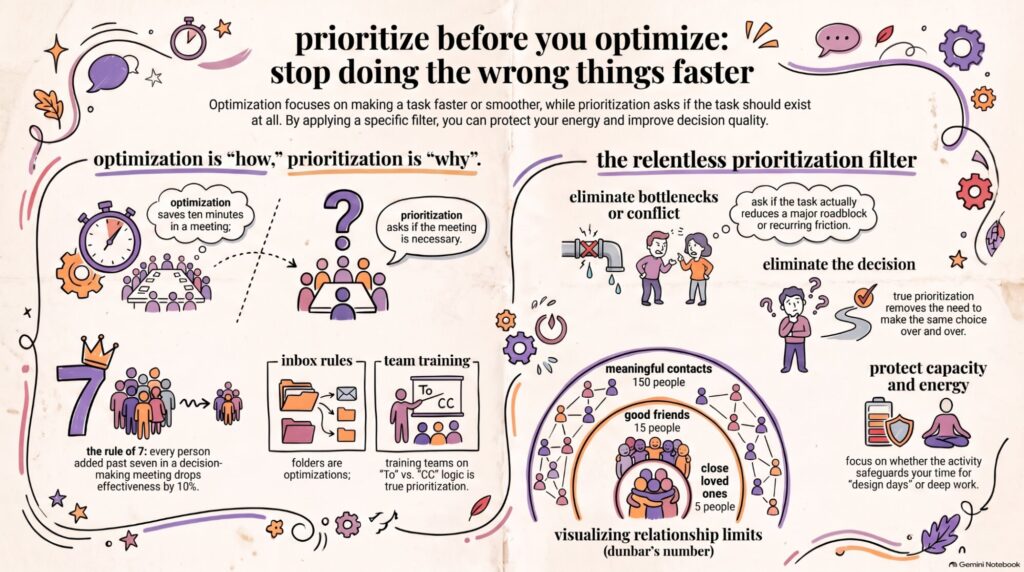
Optimization is saving ten minutes in a meeting. Prioritization is asking whether the meeting needed to happen at all. That difference shows up everywhere once you start looking for it. Here are some places I still see clients get tricked, and a few for me too.
Why It Matters
- Most productivity advice makes the wrong things faster instead of asking whether they should happen at all.
- The relentless prioritization filter works on almost anything you're already trying to optimize, from a calendar rule to a grocery app.
- The research behind "keep your meetings small" is more specific than most people realize, and it's not really about time.
What You'll Learn
- How to tell the difference between an inbox rule and an actual fix for inbox overload
- Why trimming a meeting's invite list changes the quality of the decision, not just the length of the meeting
- The difference between an auto-blocked calendar hold and a real Design Day
- What changed, concretely, when I moved from managing my social media to leaving almost all of it
The Filter
If you caught episode 127, you know the relentless prioritization filter. Three questions:
- Does this reduce or eliminate a bottleneck or conflict?
- Does this eliminate a decision?
- Does this protect capacity or energy?
You don't need the exact wording. Asking yourself even one of these before you reach for an optimization is usually enough to catch it.
Inbox
Building an inbox rule that routes anything you're CC'd on into its own folder, checked once a day, is a good move. Build it.
But prioritize first. Train your team on how "to" and "cc" actually work, because most people never learned. If you're in the "to" line, you have an action. If you're in "cc," you need access, not action. It’s FYI.
The optimization is the folder rule. Prioritization is asking whether you're still being copied on things you don't need to see, and whether requiring people to loop you in on every client email quietly tells them you don't trust them to send it alone.
Meetings
Shortening a meeting is optimization, and it's fine up to a point. Prioritization means looking at the invite list and asking why six people are on it when two of them talk for a combined five minutes.
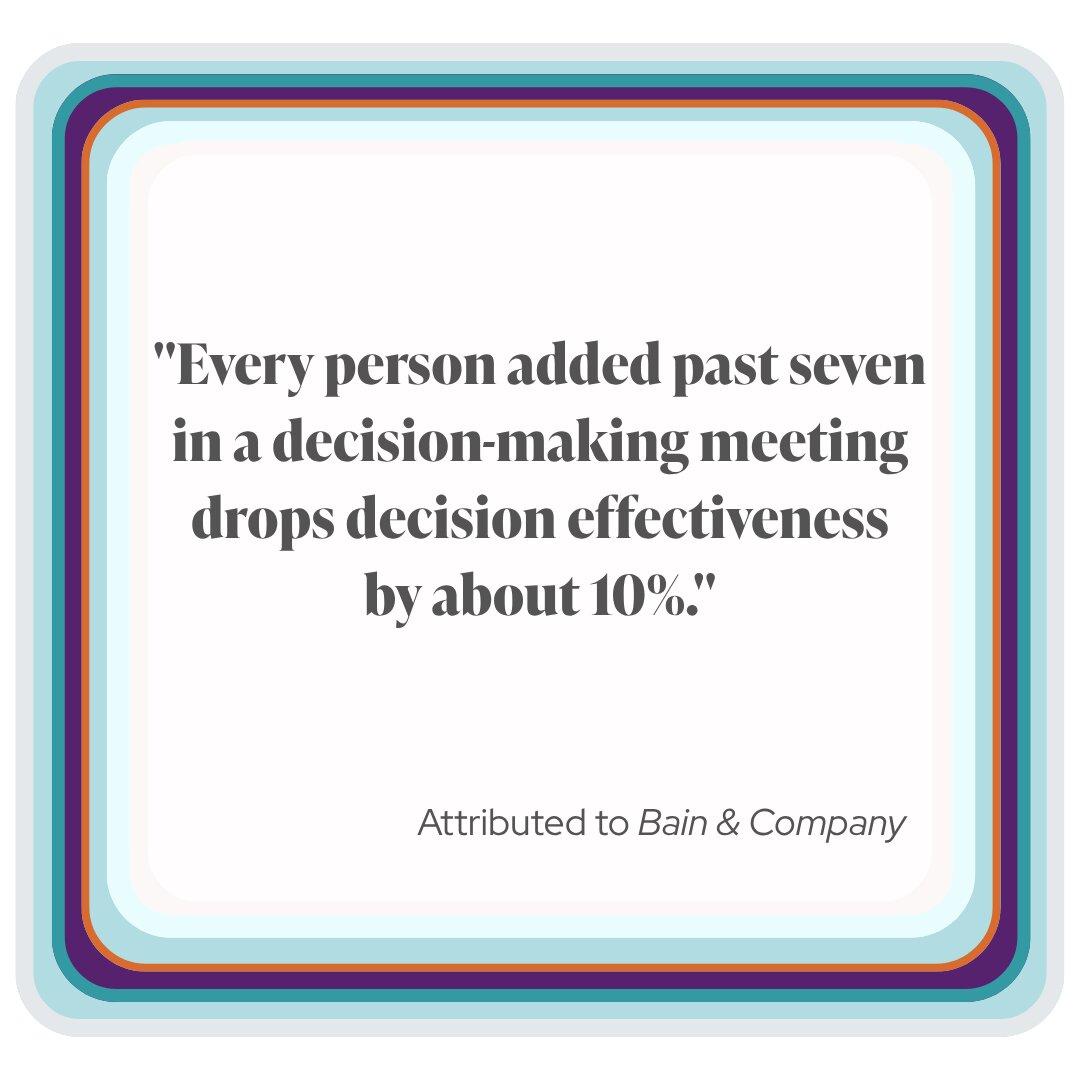
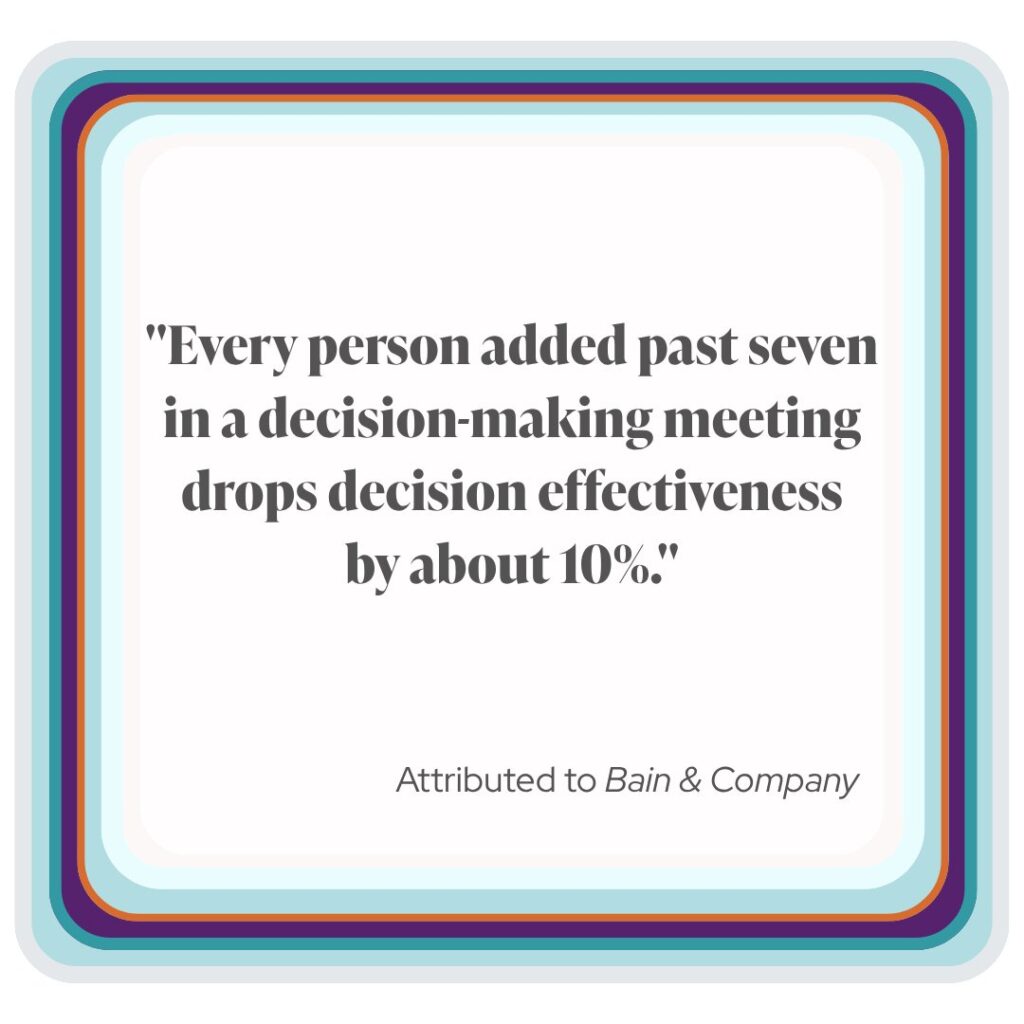
There's real research behind this. Bain & Company found that every person added past seven in a decision-making meeting drops decision effectiveness by about 10 percent. That's not a time problem. It's a decision-quality problem.
Focus Time
Letting Outlook or Google automatically block two hours a week for "focus time" is an optimization. Your calendar tool doesn't know your best hours. It just finds open space and drops a block there, and you end up scheduling right over it anyway.
Prioritization is a Design Day: one full day, one or two projects that keep getting pushed, no meetings, no calls, out of the inbox entirely. I covered this in full back in episode 69.

Sleep
I'm actively working on my sleep this quarter. Downloading an app that creates friction on my phone after 8 or 9 PM is an optimization (because most apps have bypasses). It doesn't address the real problem: scrolling fitness apps to plan tomorrow's workout, then picking a meditation to fall asleep to.
Prioritizing meant keeping my phone completely out of the bedroom. I haven't taken it inside for months. I also found a clock with zero ambient light. You touch it, it blinks on for a second, and that's it.
Relationships
Scrolling Facebook to "catch up" is optimization. It's efficient. You don't have to call anyone or have them over. Prioritizing is admitting that watching someone's updates isn't the same as connecting with them.
This connects to Dunbar's number, the idea that we can only sustain relationships at a handful of tiers: about 5 close loved ones, 15 good friends, 50 regular friends, 150 meaningful contacts, and around 500 acquaintances. My version took two steps. About 15 years ago, I optimized by trimming my Facebook friends list to 25 people. About 10 years ago, I prioritized by deleting Facebook and every social platform except LinkedIn, which I only use during business hours.
Shopping
Using grocery delivery apps is an optimization, and it's genuinely useful. What wasn't useful was the time I spent scrolling meal options across multiple apps. Prioritizing meant narrowing it down to a rotation, one app per week, and I'm cutting that down further to three.
The Close
Each of these comes down to the same catch: reaching for the faster version of something before asking whether it needs to exist in its current form at all. Optimize after you prioritize, never before.
FAQ
What's the difference between optimization and prioritization? Optimization makes something you're already doing faster or smoother. Prioritization asks whether you should be doing it at all. Saving ten minutes in a meeting is optimization. Asking whether the meeting needs to happen is prioritization.
What is the relentless prioritization filter? Three questions to run a decision through: Does this reduce or eliminate a bottleneck or conflict? Does this eliminate a decision? Does this protect capacity or energy? You don't need all three to apply. One is often enough to catch an optimization masquerading as a fix.
Where can I learn more about relentless prioritization? The Right Things First: A Pocket Guide to Relentless Prioritization covers the filter in more depth, along with additional examples like the ones in this episode.
Resources
- Episode 127: The Relentless Prioritization Filter
- Episode 69: Design Days for Deep Work
- Design Days blog post - www.helloraderco.com/design-days
- Bain & Company, "Effective decision making and the rule of 7"
- Forbes, "Why You Should Never Invite More Than 7 People To Your Meeting"
- Dunbar's number: BBC article link
- My TEDx, The Relentless Pursuit of More
- The Right Things First: A Pocket Guide to Relentless Prioritization