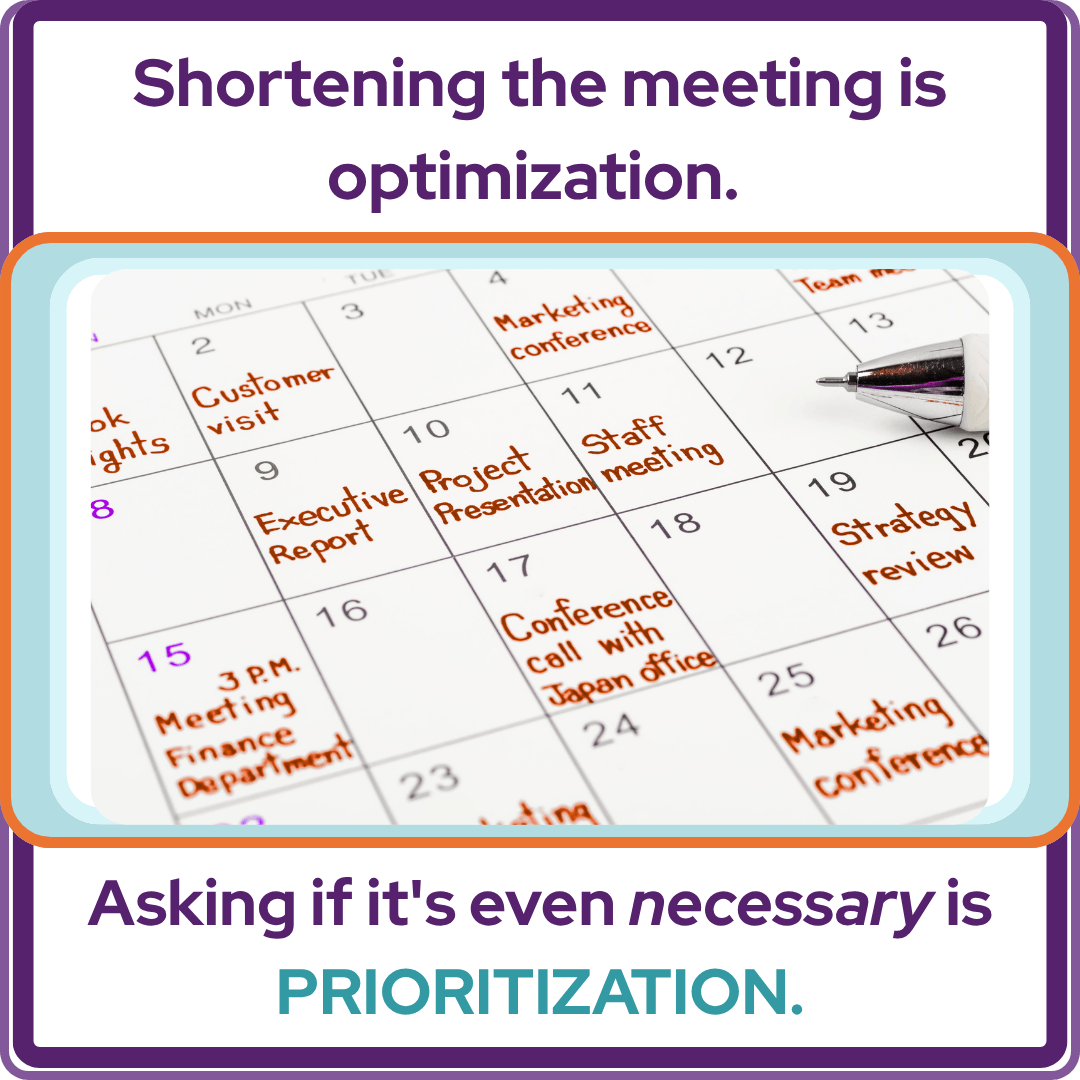
Before you shorten a meeting, improve the agenda, or redesign participation, ask whether the meeting should exist at all. This is the first step to a meeting reset.
In this podcast episode, I tackle a problem most teams try to solve too late: meeting overload. My argument is simple. The first question is not how to make meetings better. It is whether the meeting is necessary in the first place.
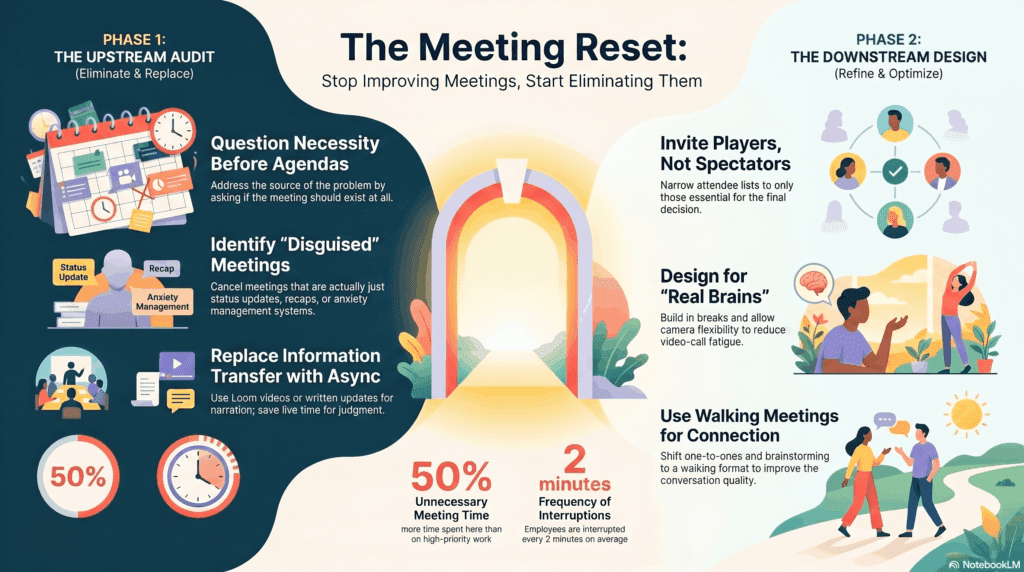
That matters because poor meeting culture does more than annoy people. It drains time, fragments focus, and crowds out high-priority work. Atlassian reports that in organizations with poor meeting cultures, people spend 50% more time in unnecessary meetings than on high-priority work, and Microsoft found that employees are interrupted every 2 minutes on average by a meeting, email, or notification.
I use a TSA-line story to make a bigger point: leaders often improve the symptom before they address the source. That same pattern shows up at work when teams shorten meetings, add agendas, or tweak invite lists without first asking whether the meeting should happen at all.
Why it Matters:
- More meetings do not equal more alignment.
- Unnecessary meetings reduce focus and create rework.
- Better meeting habits cannot fix bad prioritization.
- Video-heavy work can add fatigue, especially when meetings are poorly designed.
What you’ll learn:
- How to identify meetings that should be eliminated
- When to replace live meetings with async communication
- How to shorten meetings by reducing spectators
- Why neurodivergent-friendly design improves meetings for everyone
- How walking meetings can improve the right conversations
Why do teams try to improve meetings instead of eliminating them?
Because improving a meeting feels easier than questioning it.
Teams often start with the visible problem. The meeting feels too long. Too many people are invited. The agenda is messy. But those are often downstream issues. The upstream issue is that the meeting never needed to happen.
A lot of meetings are really something else in disguise: a status update, a recap for people who did not read the pre-work, a leader’s anxiety management system, or a conversation with two people who need it and eight spectators.
That's why I push leaders to ask a harder question first: Is this meeting even necessary?
When should you replace a meeting with async communication?
Replace the meeting when the goal is information transfer, not discussion.
A Loom video, a recorded walkthrough, or a clear written update can often do the job better when you are sharing a status update, reviewing slides, providing context before a decision, or explaining a process. Live time should be for judgment, nuance, and decisions. Not narration.
This is also a focus issue. When people sit through a meeting that could have been async, they often multitask anyway. You don't get focused meeting time or focused work time. You get both happening badly.
How do you make necessary meetings more productive?
Start by narrowing the meeting before you try to make it prettier.
Reduce the attendee list to players, not spectators. Clarify the purpose in one sentence. Send pre-work early. Identify the decision that needs to be made. End when the decision is made.
Then design the meeting for real humans. Stanford researchers have shown that video-call features like close-up eye contact and self-view contribute to fatigue, which supports my recommendation to use camera flexibility wisely, reduce unnecessary visual distraction, and build in actual breaks.
The same principle applies to neurodivergent-friendly meetings. When meetings allow time to think, reduce overstimulation, and make contributions easier, they usually work better for everyone.
What kinds of conversations should not be traditional sit-down meetings?
Some conversations should be walked, not scheduled.
One-to-ones, coaching conversations, relationship-building, brainstorming, and lower-stakes problem solving can benefit from a walking meeting. A better meeting is not always a shorter meeting. Sometimes it's a different format entirely.
The real lesson: meeting overload is a prioritization problem
This is the bigger takeaway from the episode. Meeting overload is usually not a meeting problem first. It is a prioritization problem.
When priorities are unclear, meetings multiply.
When ownership is fuzzy, meetings multiply.
When leaders avoid trade-offs, meetings multiply.
When people do not trust decisions, meetings multiply.
That's why optimization without prioritization is just organized depletion.
The meeting reset is simple:
- Ask if the meeting is necessary.
- Replace what can be async.
- Shorten what remains.
- Design necessary meetings for real brains.
- Use the right format for the outcome.
That is how meetings support the work instead of becoming the work.
FAQ
What is this episode about?
It's about resetting how leaders think about meetings by asking whether the meeting is necessary before trying to improve it.
Who is this episode for?
It's for leaders, managers, team leads, and knowledge workers who feel buried in meetings and want a more sustainable way to work.
What problem does it solve?
It helps teams reduce unnecessary meetings, improve focus, and make live collaboration more effective.
What is one action listeners can take today?
Audit the next two weeks of your calendar and ask of each meeting: is this necessary, could it be async, and who actually needs to be there?
Mentioned in this episode:
- Episode 123: Don't Improve the Symptom Before You Address the Source
- Episode 122: Loom Videos: The 5-Minute Habit That Replaces a 30-Minute Meeting
- Episode 107 - Designing Meetings for Neurodivergent Brains Where Everyone Wins
- Episode 76 - From Zoom Zombies to Async Advocates: How toBurn Down Your Meeting Culture and Rebuild it For Increased Productivity and Health
- Episode 55 - How to Have a Walking Meeting
Are you ready to bring RaderCo in to help your team reduce meeting overload, improve focus, and build a healthier, more sustainable way to work? Contact us!