Googling the phrase "How to focus at work" increased by 300% in the last year.
Our focus is waning due to rings, pings, buzzes, and haptics, the feeling that we need to always be available, and the lack of time and technology guardrails.
This is not our fault.
Social media, shopping, and news apps are made with hooks that get us into a habit of using them. In the words of the focus guru, Tristan Harris of the Center for Humane Technology, we are served a bottomless bowl that eliminates the stopping cues to turn it off or click away. Think about it....your Instagram feed is built like a casino - lots of movement, photos, videos playing automatically, and noises. A casino won't have clocks on the wall, food is served 24/7, and there is nothing to tell you it's time to stop. Same with your media. Nothing says - enough already, take a shower, start working.
Our response, compulsion, and even addictions are because of dopamine. This potent molecule drives you to pursue more. It drives desire, motivation, and craving. We get a massive hit when something grand happens. Still, we go below the baseline rather than revert to it. We stop experiencing the same level of joy. We need more and more of it. This is why some people get post-partum depression, the honeymoon blues, and astronauts suffer from depression (because seriously, what's left after space?) I felt down after completing an Ironman or adventure races unless I was signed up for another.
Every time we get a ring, ping, buzz, or haptic notification, we get a dopamine drip. Our brains get used to it, and we want to feed the beast.
Tactical and behavioral steps to focus at work
Here are a few tricks to help you better manage your attention, using technology to save yourself from yourself, as well as mental discipline and prep exercises to incorporate into your routine.
- Use an app like Freedom, which works across all devices and prevents you from going to those websites that suck your attention. You can program different periods, like keeping you out of Amazon, Instagram, and Buzzfeed during working hours Monday - Friday. You can start a 25-minute block while you finish auditing your project, which keeps you out of email, Teams, and Slack.
- Set up your Screen Time (Apple) or Digital Wellness (Android) to block or delay certain apps that distract you.
- Leave your phone in another room or at least out of reach. This study showed that just having your phone in your line of sight reduces capacity by 10% because we anticipate the ring/ping/buzz!
- Work in time blocks. Decide on the block of time you are making your work sprint, and write down (this is important) what you will do during that block. Point at the computer, say it aloud like the Japanese Point and Call method, and start your timer.
- Don't check your email first thing. Most roles do not need to hit their inbox immediately. Instead, tackle your top priority for the day, eat that frog in Brian Tracy's language, and then 'reward' yourself by checking your email.
- Think of email as a task, not a default. Stay out of your inbox, work offline, or pause with the Boomerang app. Process your email 1-4 times daily, or whatever works for your schedule. And for the love of unicorns, turn off your notifications! They are not on as the default to make you more productive. They are on to get you to use it more after each dopamine hit you receive.
- Use focus music. I use ambient music my husband creates for me, but I also recommend Brain.fm, video game music designed for concentration, and Calm's focus music.
- For advanced focus, invest in an Apollo Neuro device. It's a band you wear on your ankle or wrist and emits a vibration that works with your nervous system and can help focus, recovery, energy, and sleep.
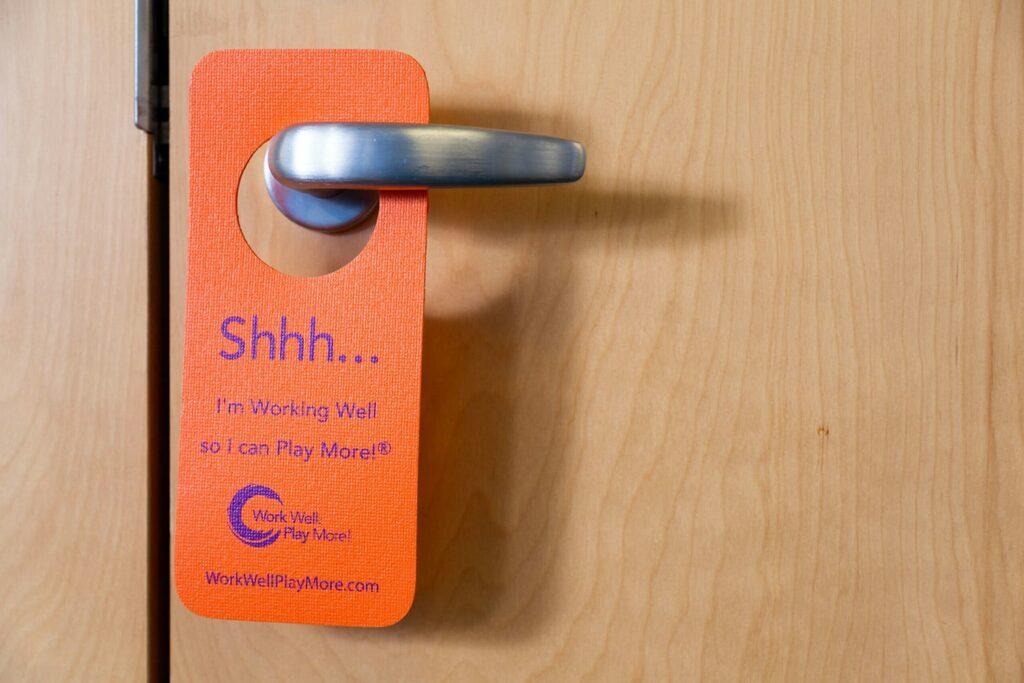
9. Wear headphones and or put up a visible sign - something to tell the people around you that you are in focus mode. I use one in the mornings, when I'm coaching or in meetings, or when I'm writing and recording. I don't leave it on all day because I'm not in focus mode the entire time. I don't put it on my door and leave my door open. When you send mixed signals and aren't consistent, it won't work.
There are many ways to focus at work, and I have an entire workshop dedicated to it. If you want a deeper dive for your company or team training, please reach out and learn more at www.helloraderco.com/training.